Author Archives: digitalnaturalism_97q4dl

Dissertation Music Video

One of the main Side projects for my 2014 tenure in the rainforest will be to shoot a music video which somehow shares the thesis of my PhD research. I was enthralled when I first started my PhD three years ago and Dr. Becky Arundale pointed me to the “Dance Your PhD project.” I knew I would have to do it, but when I started check out the works submitted currently, many seemed to be just some sort of interpretive dancing against audio backdrops of pop songs with captions that explained the thesis. This is still SUPER COOL and super great when people find more fun and accessible ways to share their work. I knew however, that what I really wanted to do was a fully realized music video performance to explain it all. I had to make a custom song that actually explained some sort of the philosophy of the research itself, and then shoot a music video to back-up these ideas.


I’m not unfamiliar with creating music videos about a central thesis. Whether it was about the high incidents of beverage spillage amongst pimp cups, or the fact that I have lots of amazing things in my basement which I have to get rid of, I have always loved the tight structure of musical videos for expressing any sort of odd concept.


In the most cynical point of view, I realized that people just want to see captivating images synced up with fun sounds. If you can make something fun with decent visual and audio rhythms, you can get people’s attentions long enough to try to share some sort of idea.


I’m also not unfamiliar with filming music in the jungle. Last year, Peter’s band all came down to visit, and we held a concert for all the animals in the jungle. Adapting such an anthropocentric event to the forest made for a fun time and a compelling concert video.

The Song

Philosophy

I started the lyrics to the song during the Gamboa 2013 field trip. I had been reading an article about Superorganisms and the auto-poesis of control systems. This was the first time I had encountered the term poesis in its original term referring to creation and production. Meanwhile I had been thinking about how my research stood against typical scientific technological endeavors. One thought I had was that the overall goal of many technological works is to separate, and distinguish ourselves against the other facets of the world. We then dissect these “others” in order to dominate them. The target of my research, on the other hand, is to find technological means of granting greater agency to our surrounding environment. I want to dissolve the specialness of humans by finding ways for them to connect with the other pulsing creatures and environments forming the big pulsing body of the earth.

I had a vision of humans as little more than a simple appendage like an arm on the earth’s body. Currently this body part developed cancerous ideas of individuality and is currently attempting to cure itself by making saws to cut itself off from its own body.  I thought that a large philosophical target for Digital Naturalism then should be technologies which extend the reach of ourselves as these body parts and generate connections back to the other body parts. Our role in the body of the earth can develop into responsive nervous systems connecting the disparate appendages. Eventually helping the body function in tighter unison rather than staging a hopeless coup against it. Thus I had the basic principles behind a song with the awkward title: “Poetic Appendage.”


Creation

I would jot down a couple of lyrics that I felt should belong somewhere in the song. I would then pick some of these phrases and go on jogs and shout them around to develop different verses guided by the rhythmic structure of my running. I then started teaching myself how to better switch around chords on a guitar, and started to take these verses from the jogging sessions and add melodies. I eventually refined and developed a basic rhythmic structure with a standard frame of Verse-Chorus Verse-Chorus Verse-Chorus Bridge Verse – End, and simple chords to go along. Luckily then I managed to bump into an old friend Chris Gonzales. Chris is a recording mastermind. He has sound cards larger than my computer, and special boxes in the recording studio he built to give the room perfect warm audio qualities. We had worked together before on a raunchy song about sex with E.T. (this will be released with the full album after my PhD), and he seemed happy at the idea of working with me again on another musical project.

Chris’s interest was really super awesome for me, and I am really grateful he wanted to work with me. We met up and I shared the song and rudimentary philosophy and ideas behind my PhD, and he took to it right away and started thinking of ways to have the music and the recorded quality of the music represent the rhetoric and narrative of the ideas behind the song.


He used his fantastic guitar and drum skills to then get the core skeleton of the song together. Then I recorded the lyrics. Despite my usual demeanor, there’s something about singing that makes me INCREDIBLY SELF CONSCIOUS to the point where it is hard to actually sing. But battling this affliction, I think, is one of the main reasons that I keep forcing myself to do it (jpom.bandcamp.com). I still feel weird about hearing my voice on the song.


Finally we took lots of Peter’s recorded sounds of panama (petermarting.bandcamp.com), and I edited these clips of howler monkeys, cicadas, tropical birds, and frogs into the song. I also added some funky appegiatted synths to the mix so that all three main actors in the concept of the song (humans: guitar, drums, vox – Animals: Jungle Sounds – and Digital: Synths) would all be jumping around together.


The Song

{Is still currently being refined, check back later to hear it!}

Here’re the lyrics and chords to play it yourself!


The Video

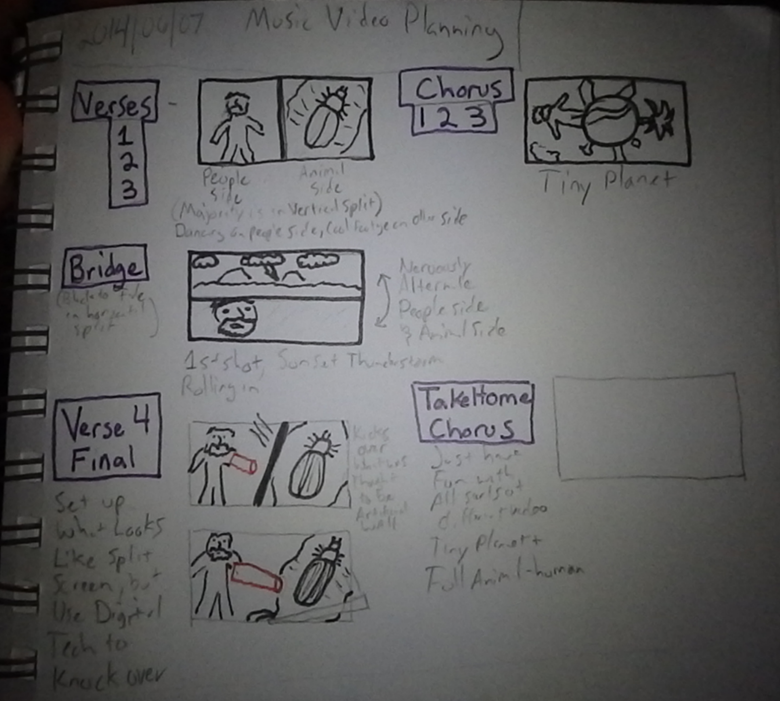
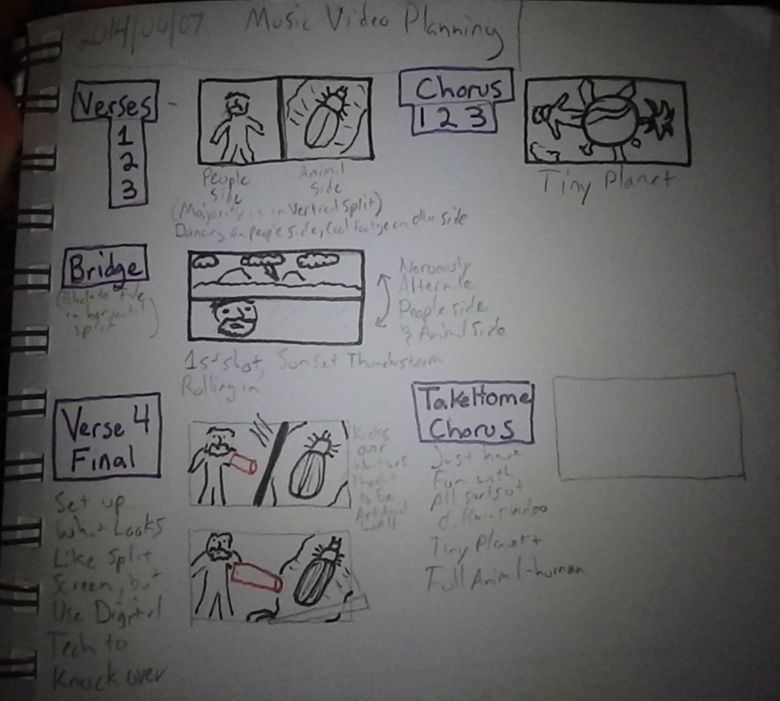
{Is also still currently being refined, here’s some descriptions of the planning for it so far though.}
image

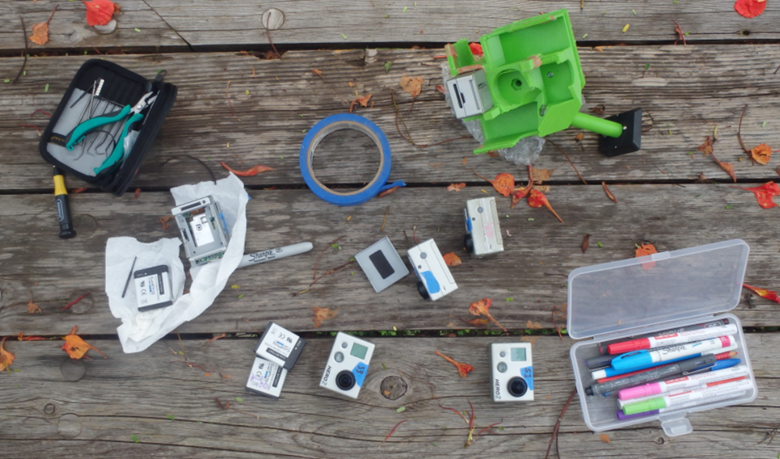
The verses will be shot in split screens. This will enable me to do fun dancing and stuff on the human side, and share cool nature videography on the creature side while supporting the thesis about technology and separation from the creatures. The aesthetic of the choruses are based off the “Tiny Planet” spherical video panoramas taken by GERMAN GUY INSERT NAME. I had to build a modified version of his 6 gopro camera holder to use with Gopro Hero2’s (not rich enough for 6 hero 3’s). Unfortunately one of the Gopros I bought off ebay had a faulty button, and I tried to fix it, but it just broke again – lame!
image

Gamboa 2014 Thesis Field Season


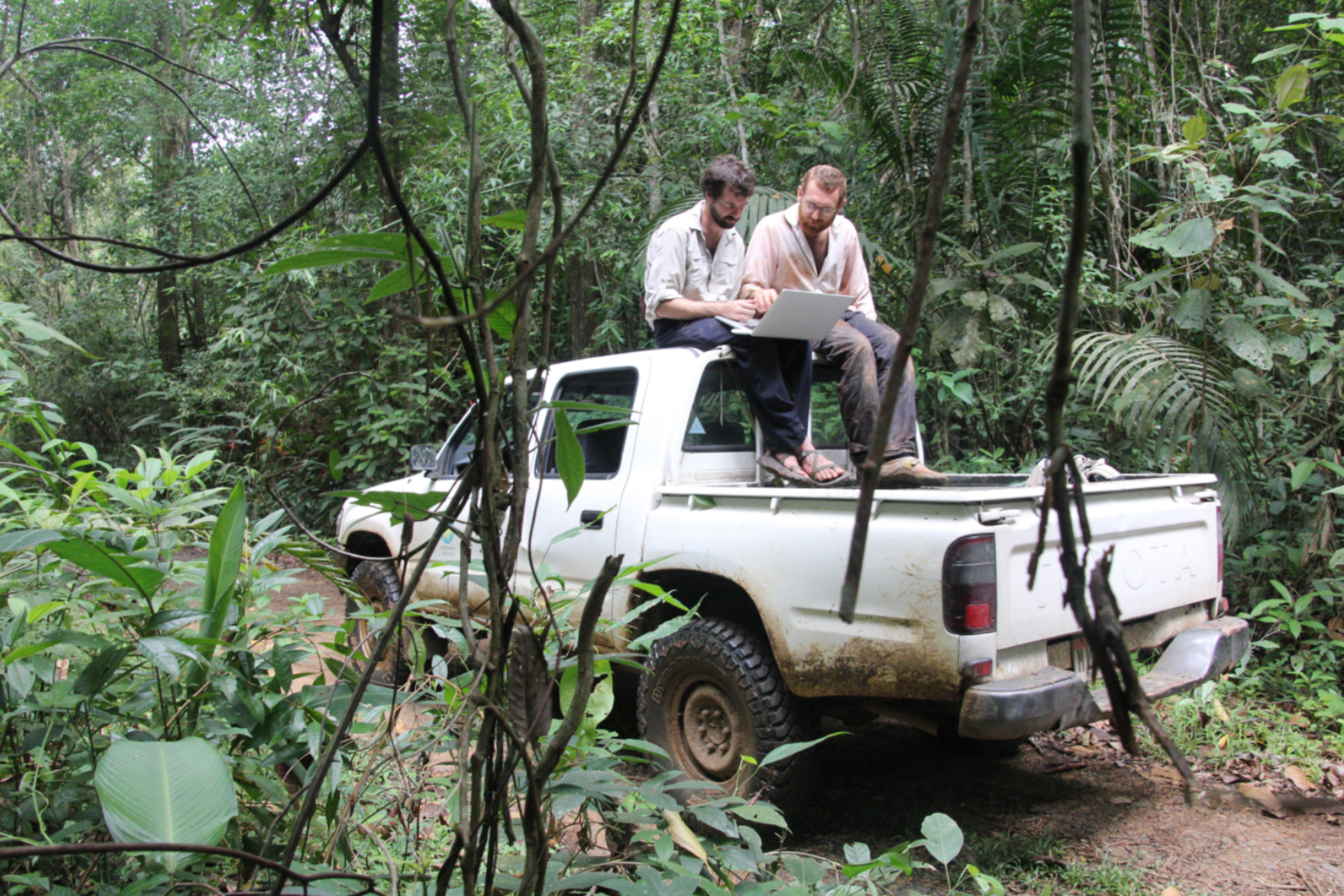
Having successfully defended my Proposal in February 2014, I am conducting my final field season for my PhD. This is the longest field season where I will be down in Panama for a full 3 months to test out and evaluate the Digital Media theories I have developed over the years of my research.

This year I will have three main projects, designing an ant sensor, hosting a hiking hackathon, and filming a music video for my dissertation:
[display-posts category=”projects2014″ include_excerpt=”true” image_size=”thumbnail” wrapper=”div”]
Here are my journal entries for the season:

[display-posts category=”gamboa2014″ include_excerpt=”true” image_size=”thumbnail” wrapper=”div”]

Arboreal Ant Sensor: Main Project Summer 2014

Background: Funding

After a couple years of trying to pitch lofty, abstract concepts for funding from the Smithsonian Tropical Research Institute, I changed up my strategy with great success! I went from rejected proposals such as “Give me money so we can do large scale exploratory performances with crazy technology in the jungle so that people can feel what it’s like to be an ant” to “Let me build an ant sensor” and surprisingly enough it got funded 🙂

As with all things in life, I realized that the reason I was having trouble getting funded last year was due to communication problems. No one should really be expected to just flat out accept big vague ideas that they have no real connection to what’s being proposed. So after doing lots of exploratory “Digital Naturalism” stuff last year, i decided it would be a good idea to take one of the projects that developed from this process, and present a very concrete idea that could gain traction among the scientists on the review board.

The basic concept

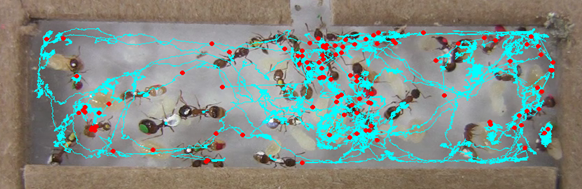
In the lab, we can track lots of ants with cameras pointed at the colony in a nice 2-dimensional plane. In the field however, the ants live on arbitrary geometric shapes- up the bark of a round tree  and onto frilly leaves, for example.

While working with Peter, we had been adopting the computer vision techniques from the lab in field sites with little success. However, after our work designing, utilizing and performing with the technology together in the jungle, we were able to start analyzing our problem from the ground up.


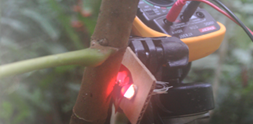
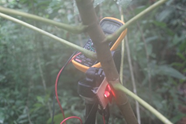
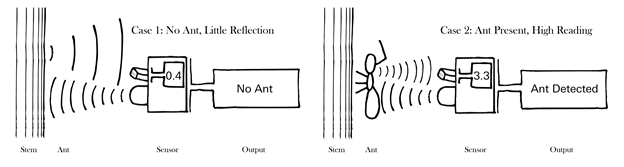
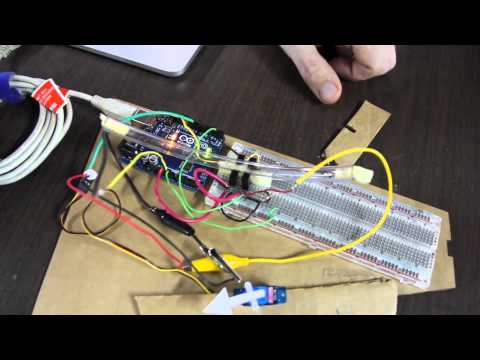
For Peter’s experiments, we realized that we didn’t need all the data that the lab tools were working to collect like, ant position, unique ID, orientation. Instead what we could really use would just be something that told us there mere fact that an ant was there or not. In the little time that I had last year, I made a really simple ant-detector prototype. An LED gives steady illumination to a point on the tree bark, and a photo-resistor gives a reading of how much light gets reflected back. When an ant walks in front of the area where this simple sensor is pointing, it reflects the light differently and gives a different reading.

This early prototype showed lots of promise. Once implemented, we can potentially build cheap, sub $10 sensors that could be attached in arrays to arbitrary surfaces in the jungle. This would be a different means of tracking the insect movements with its own bonuses and limitations.

Camera Tracking Modular Sensor Tracking
 Single Unit – Expensive  Multiple Cheap Units
 Rich Potential Information: Speed, Unique ID, Orientation, Multi-ant Interactions  Minimal Information from single source: Ant Present, Yes or No.
 Single Location, 2-dimensional  Multiple Locations

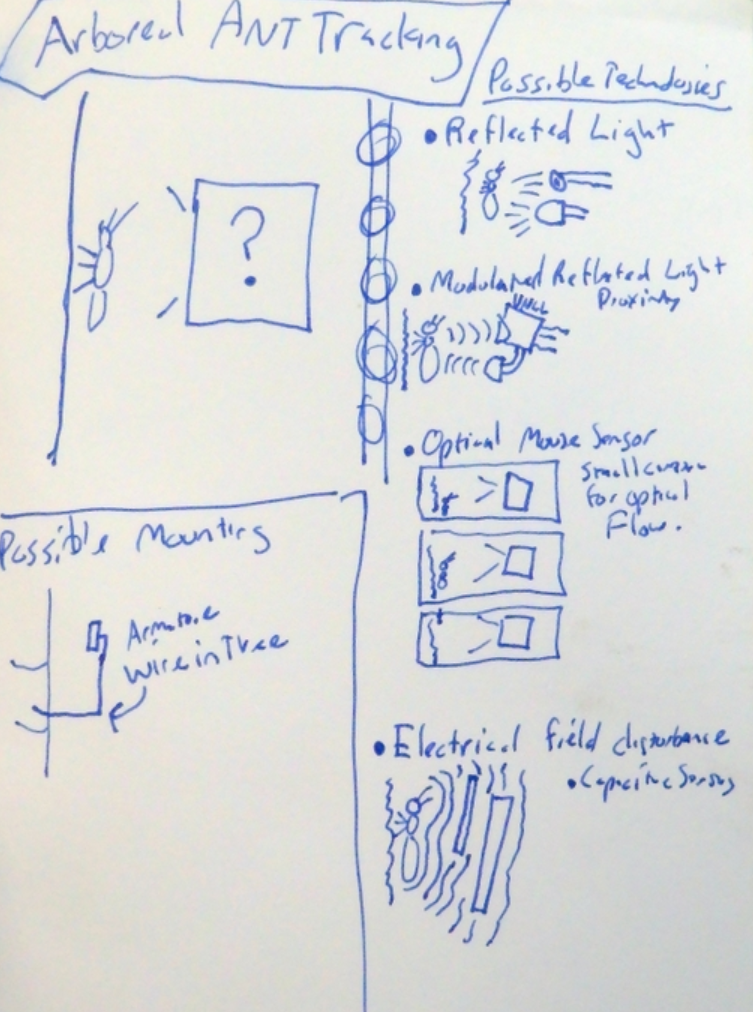
All Potential Technologies

Since I have learned the lesson over and over that everything will go wrong, and most things you assume to work will not, I came with several contingencies plans of different technologies which could also potentially work.

Reflected Light

Building more sophisticated versions in keeping with the original LED + Photoresistor sensor.

Modulated Light / Proximity Detection

This is the next step up from the original idea. The output light is pulsed, so the sensor knows exactly when to expect readings (cutting down on noise). Depending on how these readings come back, fancy sensors like the VNCL4000 (https://www.adafruit.com/products/466) can actually give distance

Optical Mouse Sensor

Right before I left for panama, Sparkfun started selling optical mouse sensors (https://www.sparkfun.com/products/12907). These chips are SUPER CHEAP ($1), and are actually high-frame rate cameras design to detect changes of movement in their visual fields. I ordered a bunch, and will try to see if I can rig them up to monitor patches of bark or leaves for the movements of any passing ants.

Electric Field Proximity Sensing

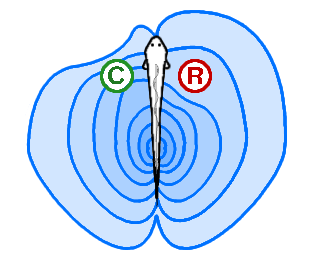
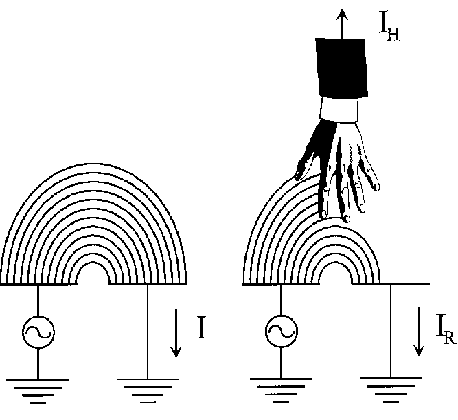
This option could be cool, because if successful, we could potentially detect ants within the trees themselves. This type of technology uses emitted electrical fields and senses any changes in the field strength it monitors coming back. Joshua Smith tested out a lot of this technology back in the 90’s with lots of sucess with Humans (we are big conductive blobs of water). In order to detect ants, this might not work at all (they are small dry and barely conductive). But if all other methods fail, this could be a cool thing to resort to.

http://en.wikipedia.org/wiki/Electric_field_proximity_sensing


Transcontinental Hiking / Hack Announcement

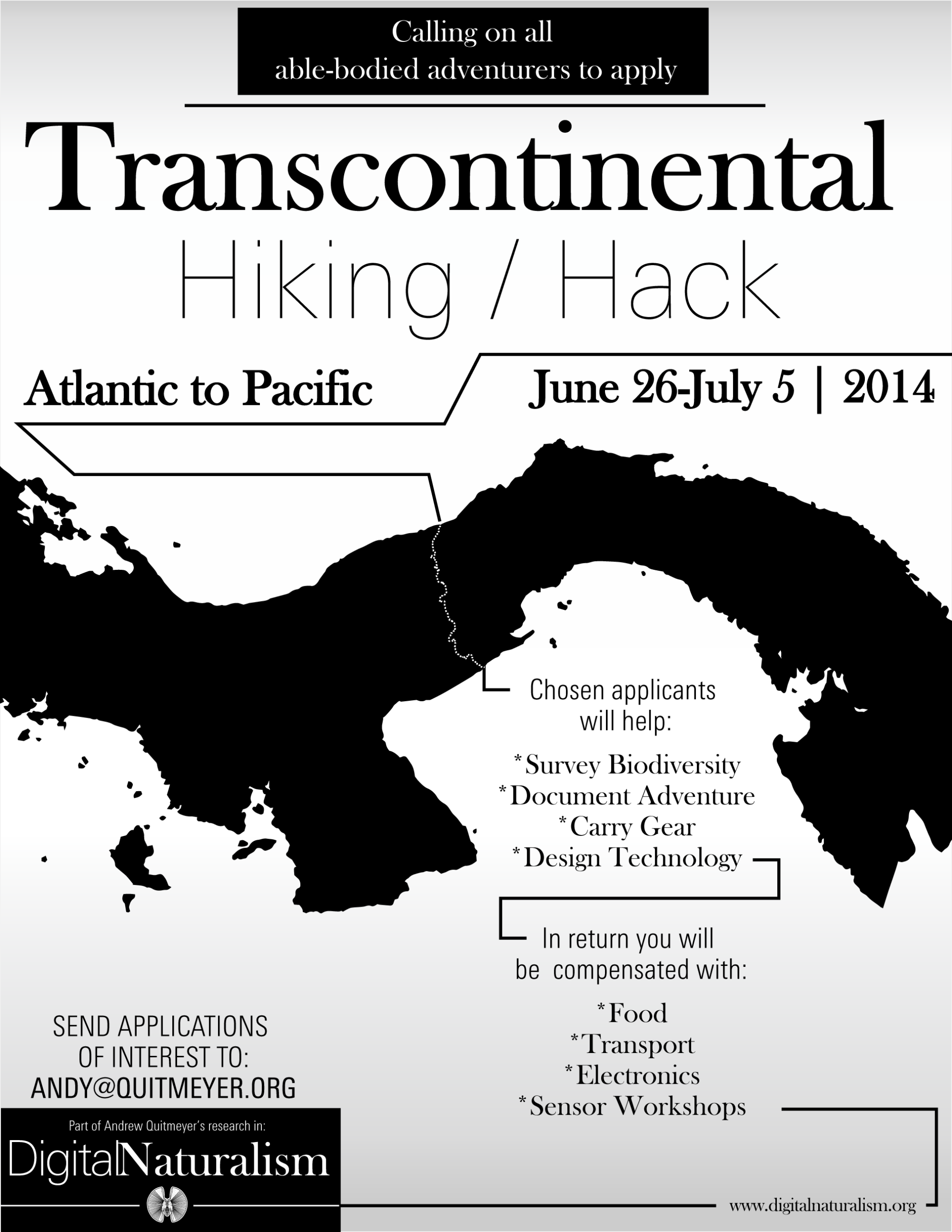
We are recruiting field biologists for the upcoming Transcontinental Hiking / Hack. This will be a 9 day hiking workshop through the Panamanian forest going from the Atlantic to the Pacific taking place from June 26-July 5 2014.

The primary goals of the project are to:

  • Design technology for studying animal behavior in situ.
  • Conduct a Basic Biodiversity Survey of the Area.
  • Raise ecological awareness

Chosen Applicants will be compensated with:

  • Free Food
  • Transportation for individuals already located in Gamboa Panama to the start of the Trail, and from the end of the trail back to Gamboa. (You need to arrange your own means of getting to Panama).
  • Electronics
  • Training in basic programming, physical computing, sensor creation, and interaction design

Applicants will be responsible for:

  • Helping design and carry out the scientific survey
  • Documenting the Trip
  • Carrying Gear
  • Participating in the proper training before the trip (Meetings, emails / 1 workshop in Gamboa, Panama)
  • Participating in the mobile workshops during the trip
  • Participating in a documentation workshop after the trip


We have 2-3 slots available. Anyone is welcome to apply by emailing: andy@quitmeyer.org . Put “Hiking/Hack” in the subject line, and describe why you wish to join our crew.

This is part of my own research in what I call “Digital Naturalism.” I seek to understand how we can develop technology with scientists for the study of animal behavior in natural environments. I seek to design technology for the full ethological process, from early open-ended exploration, to rigorous experimentation, to embodied and interactive dissemination.

Any further questions, please let me know!
Hike-and-Hack_Large

Living Lightning: Critical Making Workshop and Performance

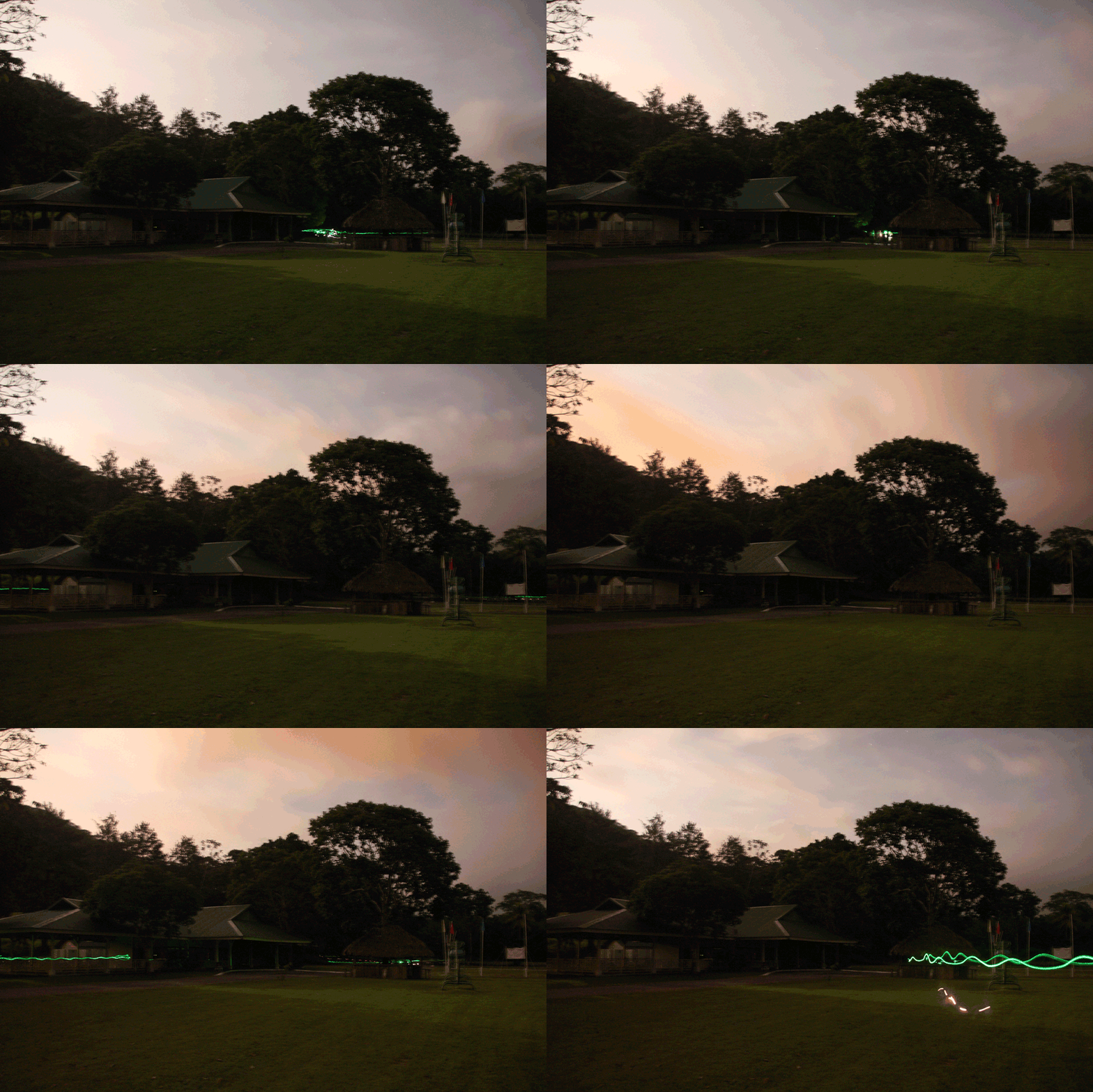
LivingLightningTimelapseLoop

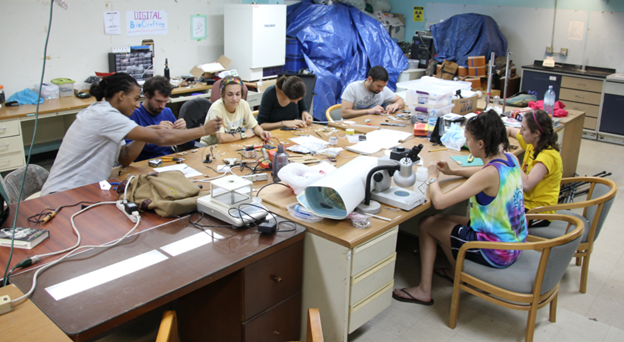
One of the largest projects carried out during my fieldwork demonstrates the abilities of both types of critical tools. Living Lightning developed in Panama during the summer of 2013. It originated from one of our mini-challenges to the scientists-collaborator, Peter Marting, to go as deep as possible into the farthest section of his field site. It grew dark, and the road deteriorated as our truck penetrated deep into the jungle. When we reached our limit, we stood outside and observed the darkness. There were bright green lights we noticed in the woods, and when we stopped, the lights slowly drifted towards us. The huge Pyrophorus noctiluca luminescent beetles were attracted to the running light on the truck. Watching the bright lights drift through the now blank canvas of the darkened forest inspired me to design a workshop and performance that would let us experience this foreign experience of the beetles.

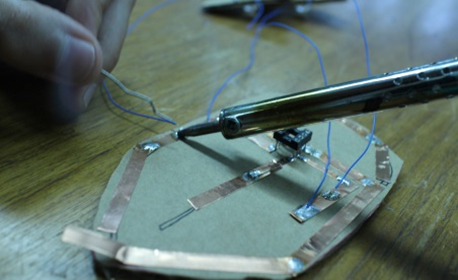
This experience led to the design of a simple, introductory 1.5 hour collaborative workshop, where scientists made their own firefly costume which we then wore into the jungle to re-enact their behaviors ourselves. Fireflies’ visual communication meshed well with my intentions to lead basic technology lessons, as I was able to build off Physical Computing’s version of the “Hello World” program, the standard blink example. These hand-built wearable devices outputted a programmable custom flashing pattern, and take a simple input from a mouth piece (to keep hands free for nighttime jungle-walking) all connected to an 80-cent ATTiny85 microcontrollers. This design gave a concrete motivation, while letting participants quickly tackle most physical computing basics, including soldering, polarity, circuit design, IO, bootloaders, and programming.

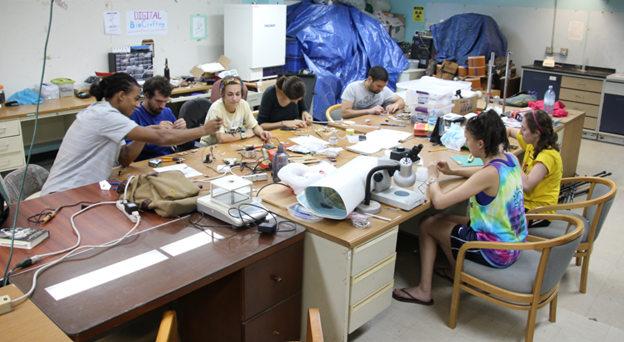
As more than a skill building session, however, the workshop component of Living Lightning was created to encourage material reflection following the Critical Making tradition. In Ratto’s original Critical Making workshops, he periodically “interrupted the teams to ask them to reflect on the kinds of help they were getting from digital resources, what help they received from their teammates and others in the room, and how the materials themselves informed their decisions.”[1] Again, while this workshop lead to the fabrication of a functional object, our critical making goals focused on the reflective, collaborative engagement with the materials themselves. Like Ratto states, “Therefore, while critical making organizes its efforts around the making of material objects, devices themselves are not the ultimate goal. Instead, through the sharing of results and an ongoing critical analysis of materials, designs, constraints, and outcomes, participants in critical making exercises together perform a practice-based engagement with pragmatic and theoretical issues.”[2]

Figure 2 – Critical Making in Digital Biocrafting Workshop.- Building Firefly costumes

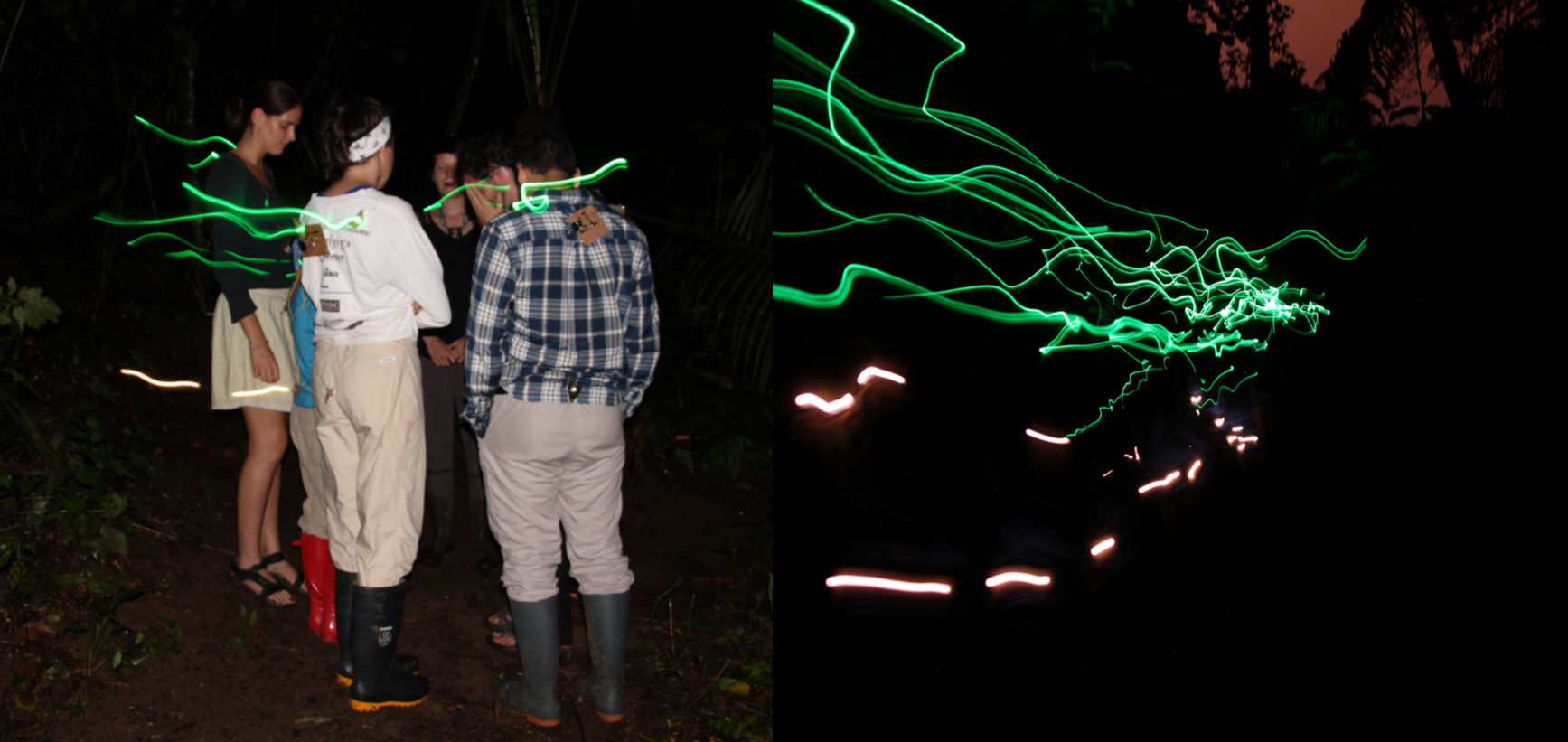
Figure 3 Performing the Fireflies’ behaviors in their Environment

In our sessions, the participants “purchased” the components, such as LEDs, or wire, at each step of their design by receiving different reflective prompts which they were asked to meditate on while building and discuss with others. Questions such as “What part of your tool can tell a lie?” or “which of your animal’s senses would you want for yourself?” were designed to lead to critical analysis of the technological, biotic, social, and environmental structures pervading this project and their research.

On the Performance Studies side of the project, acting with the devices into the fireflies’ natural habitat, the dark jungle provided additional levels of analysis upon the actions of the different constituents of the performance[DN1] . An interview with a local firefly expert let us design our basic script. This literally follows Crease’s statement about the theatricality of sicence that  “a theory, we might say, scripts a phenomenon.”[3] The mating ritual of fireflies sees the males roaming the forest, broadcasting a specific pattern of light, and searching for a female-specific response. The females sit and wait, and respond only to the most attractive of males. Transforming these behaviors into our performance, lead to a hide-and-seek style game where participants with female gendered costumes, hid in the woods, selectively flashing their costume in response to passing males. The participants had also programmed various Arduino “brains” with different genders and variations of the firefly patterns (and even predatory mimics), allowing them the additional ability to swap personas between different rounds of the mating game that emerged.

The most obvious point for reflection in this performance came from our own experience in tweaking the emergent gameplay. Embodying this behavioral system revealed the pros and cons of light communication in a forest environment for instance. In the pitch black forest, one’s sensitivity to seemingly insignificant variations in flashing patterns was heightened. Crawling through the abstract environment, one felt the strangeness of peering through alien eyes. The sporadic breakdowns back into of normal human behavior that occurred during these sessions, such as talking with passers-by became enframed as inauthentic to this experience, and led to manipulations in the rules, such as “no-talking.” Improvisations[DN2]  one made to correct accidents in behavior, such as approaching another male stirred one’s mind into eager thinking about how actual fireflies made these changes.

This performance also provided reflexive engagement with our animal audiences. Our costumes attracted not only other gameplayers, but sometimes actual fireflies as well. The inverse also came true during some play sessions where an individual was led off into the woods chasing a real-life firefly instead of a participant. These were special moments where we were able to directly observe, from within a dynamic behavioral system itself, the triggers and corrections the fireflies would make as different aspects of our actions and costumes attracted or frightened off the animals. Our back and forth interplay with the creatures themselves confronted directly with Schechner’s statement that, “Whatever the human cultural aspects of play, there are also ethological aspects. Ethologically, play and ritual are closely related. Just as human ritual has roots in nonhuman animal behavior, so play has been observed in many species.”[4]

Lastly, these performances brought our attention to the roles played by the environment and the tools. Like Crease notes, “A performance is fresh and unique when it is synthetically attuned to the specific conditions of the environment in which it takes place”[5] our performance as fireflies was inseperable from the habitat of the inspirational creatures. Unable to fly ourselves, we grew immediately aware of the difficulties of terrestrial navigation in a tangled forest with low-light conditions. Our limited locomotive abilities, made us also aware of the three-dimensional shape of our “stage” and the restrictions we had to place on the performance because of this. Placing ourselves in a unfamiliar context with limited abilities, also drew our attention to unknown components of the environment. For instance, the lack of light drew our attention to hidden patches of a faint bioluminescent fungus which is invisible in most light.

Overlooked environmental factors, such as the thick tangley-ness of the jungle spurred reflection on the technologies behaviors, and how participants might tweak the design for different engagements, such as by sewing in loose wires of the costume to one’s actual clothing. Broken devices also lead to some participants figuring out ways to puppeeterr the flashing of their suits by tapping a battery against the legs of an LED. The persistent periods of restructuring and reflection built a heightened fluency in the participants. For example after one performance session, several participants traveled into the city for the weekend, and on the bus repaired and adapted their costumes for dancing at nightclubs.


[1] Ratto, Matt. “Critical Making: Conceptual and Material Studies in Technology and Social Life.” The Information Society 27.4 (2011): 252–260.

[2] Ratto, Matt. “Critical Making: Conceptual and Material Studies in Technology and Social Life.” The Information Society 27.4 (2011): 252–260.

[3] Crease, Robert P. The Play of Nature: Experimentation as Performance (Indiana Series in the Philosophy of Technology). Indiana University Press, 1993. Print.144

[4] Schechner, Richard. Performance Studies: An Introduction. Routledge, 2002. Print.

[5] Crease, Robert P. The Play of Nature: Experimentation as Performance (Indiana Series in the Philosophy of Technology). Indiana University Press, 1993. Print.126

Leaf 5 Lover


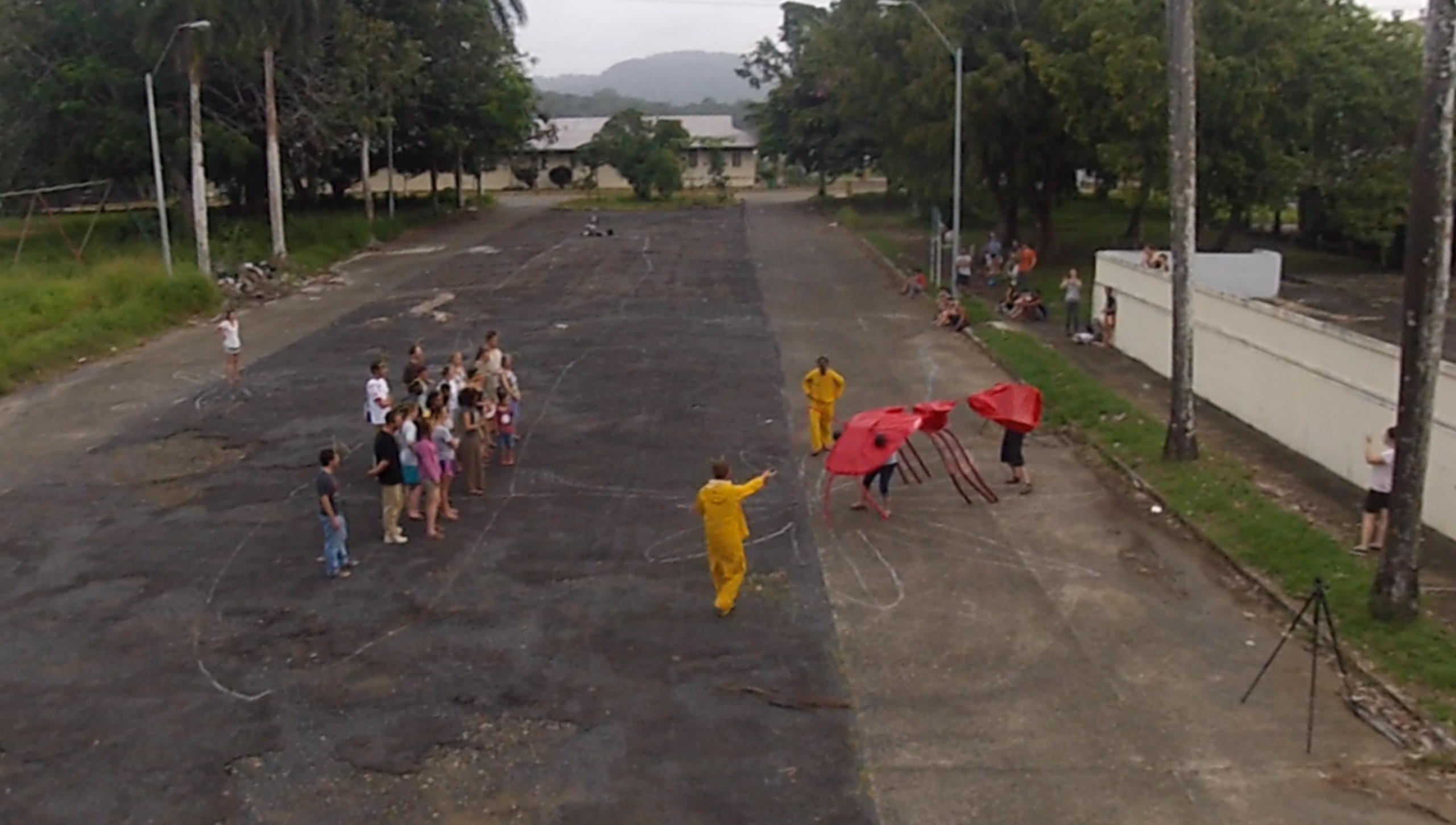
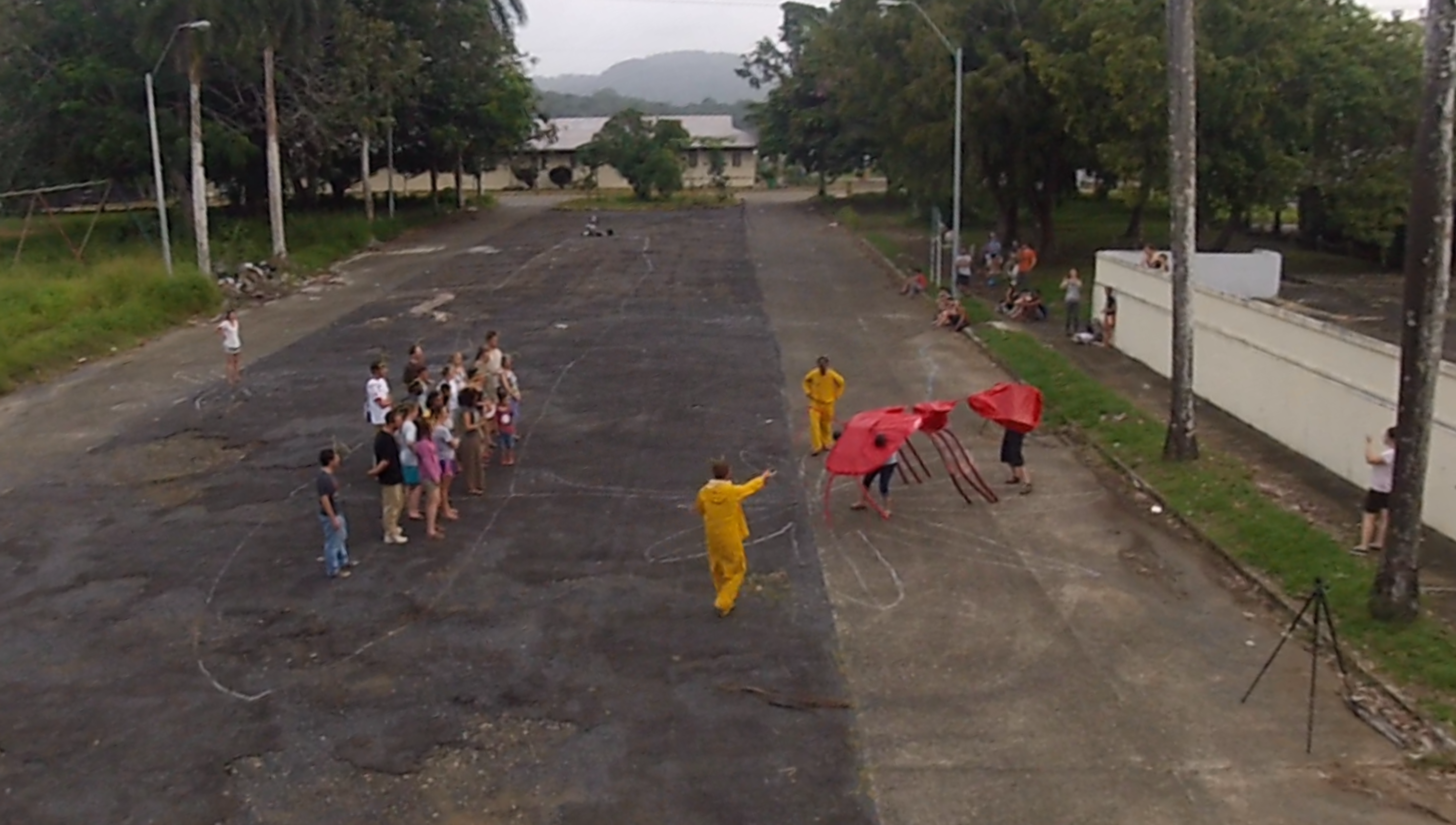
In wrapping up my 2013 field season, I challenged my partner Peter Marting to express his research as a performative love story. In just a week, we managed to put together a 30-minute play featuring dozens of actors and audience collaborators, costumes, and an 18 foot long Leaf Cutter ant puppet.

FULL VIDEO DOCUMENTATION COMING SOON


Input / Output Examples

In June 2013 I held a small workshop to demonstrate simple devices that scientists could use in the field for sensing or acting within environments.


[display-posts tag=”currentprojects” include_excerpt=”true” image_size=”thumbnail” wrapper=”div”]

Music: Biopoesis and Ego Solvent

I have never been really good at music, but I have always been compelled towards it. I remembered hating being forced into band in 6th grade. Music did not make much sense to me. You were given a list of absolute commands, and then judged upon how well you could become a robot that repeats these instructions. To me, this seemed like an alright thing to do for a little bit, just to get an idea of how frequencies and rhythms were encoded onto paper, but once you had that part down, it seemed like the appropriate thing to do would be to program a synth or computer to perfectly replicate whatever you composed. The playing of the actual instrument itself seemed a flawed a pointless pursuit to me then. I felt that the only value in making music could come from composing new songs. However no one could really describe what the true point of music was anyway. Other arts seemed to have absolute value at least in representation; you could paint a picture, or make a sculpture to obtain a lasting record of parts of the world. There was nothing we were explicitly replicating with music however.

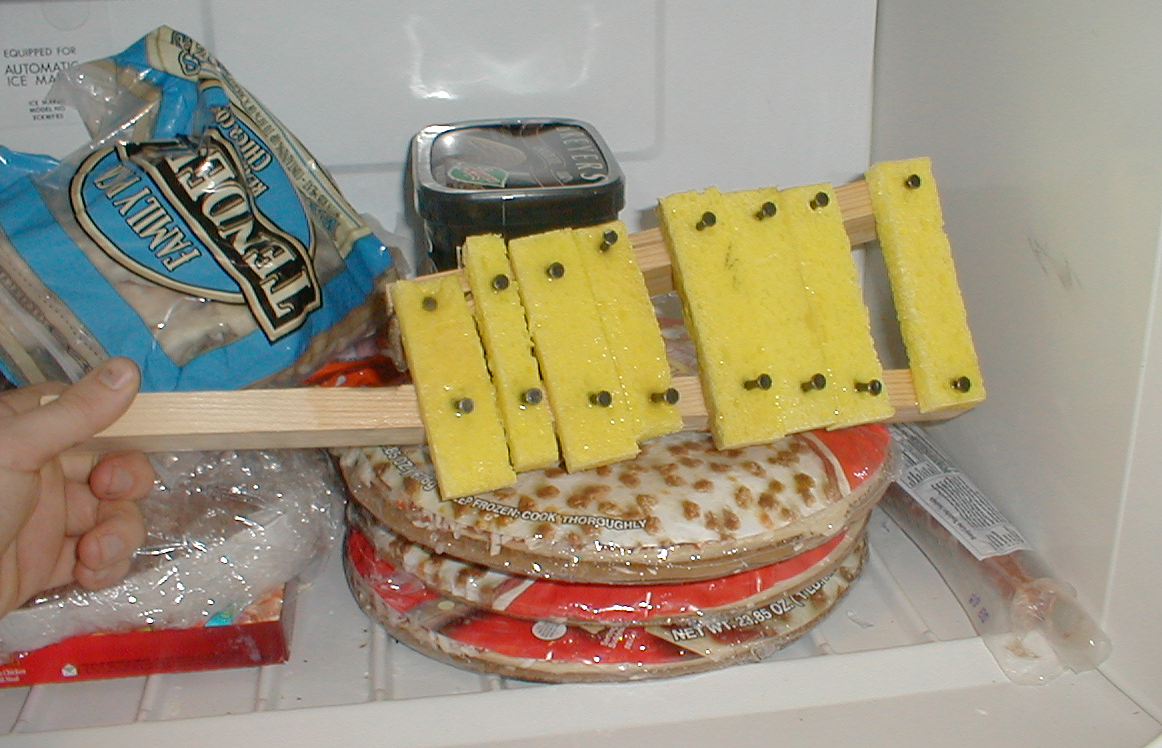
Experimental Musical Instrument by JPOM (“Mushy Lightning”)

Music had no explain-able higher purpose. You did things because they sounded good, and things sounded good if that’s the way we were used to hearing them. It strictly relied on following conventions agreed upon unconsciously by our culture. Particularly when I was younger, this notion of following conventions purely for the sake of appreciation by others seemed to be the antithesis of creativity.

I still appreciated good songs and secretly admitted to myself a fondness for popular catchy tunes, but the schism between analytic and emotional appreciation of music just drove my curiosity further. I sought out music that broke conventions and did strange or discordant things that you could grow an appreciation for like Zappa, Aphex Twin, John Cage. No matter what, though, I could still get a terrible song by Train stuck right in my head.

So I had this slow burning question that I always carried with me from a very young age:

What is music?

What is its function? How does it work, and why do we enjoy it?

The first thing I did when I moved away from home in High school was create a band to violently deconstruct music (http://jpom.bandcamp.com/). Maybe by stripping it down, I could finally see the naked truth of music.

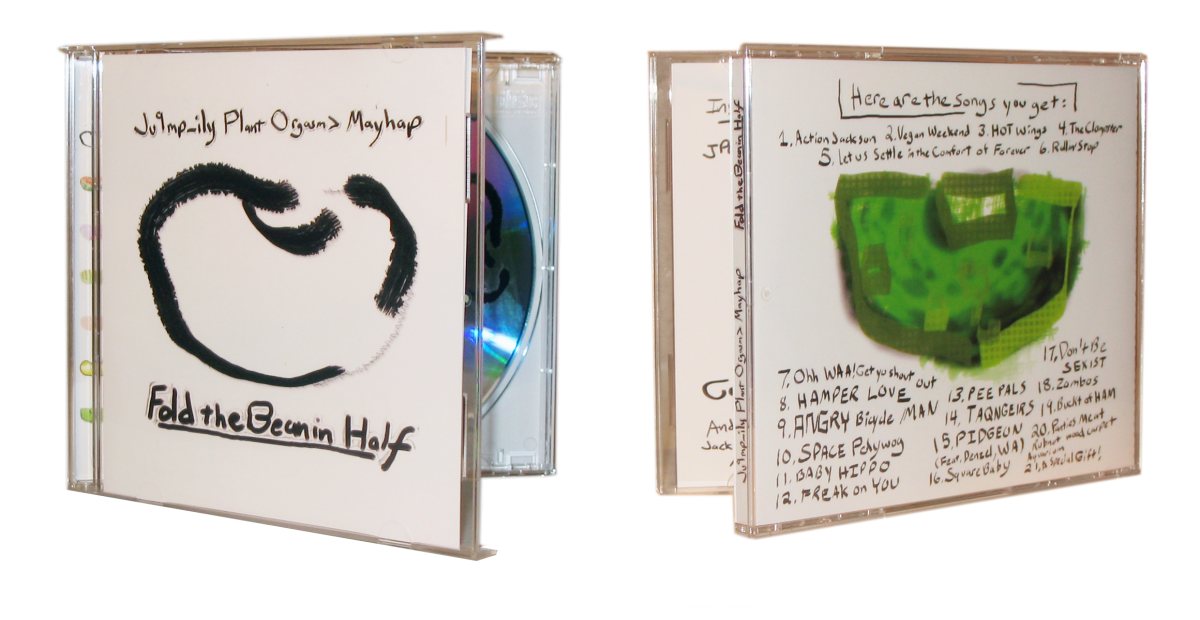
Cover of one of our first albums

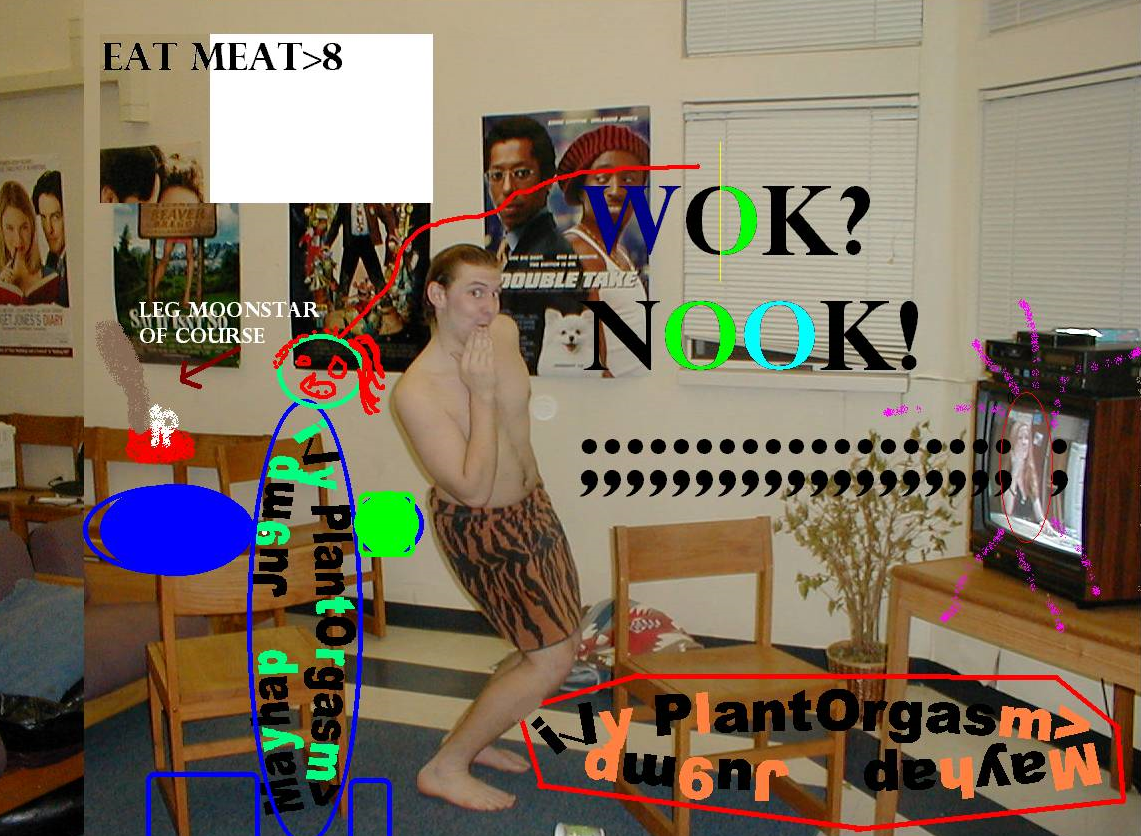
Even the band’s unpronounceable and unreadable name, Ju9mp_ily PLant Orgasm > Mayhap, was developed for cognitive jamming. Scientifically speaking, the methodology involved to pursue this inquiry involved taking one assumption and then applying one algorithm.

Assumption: we were the best band on earth, and thus had unlimited creative freedom to define an artifact as “music.”

Algorithm: if I could identify a musical convention or standard, I would try to do the opposite.

A lot of this is your standard teenage contrarian-ness, but I very consciously always tried to channel this push to inversion towards its limits in investigation and general weirdness. The first thing to destroy  was any pre-determined roboticism about creating music. So no rehearsing, no aiming for particular notes, no written poetry, just fill a room with energetic people, hit record for a certain amount of time and accept what results as the purest of music.

JPOM-FOld-the-Bean

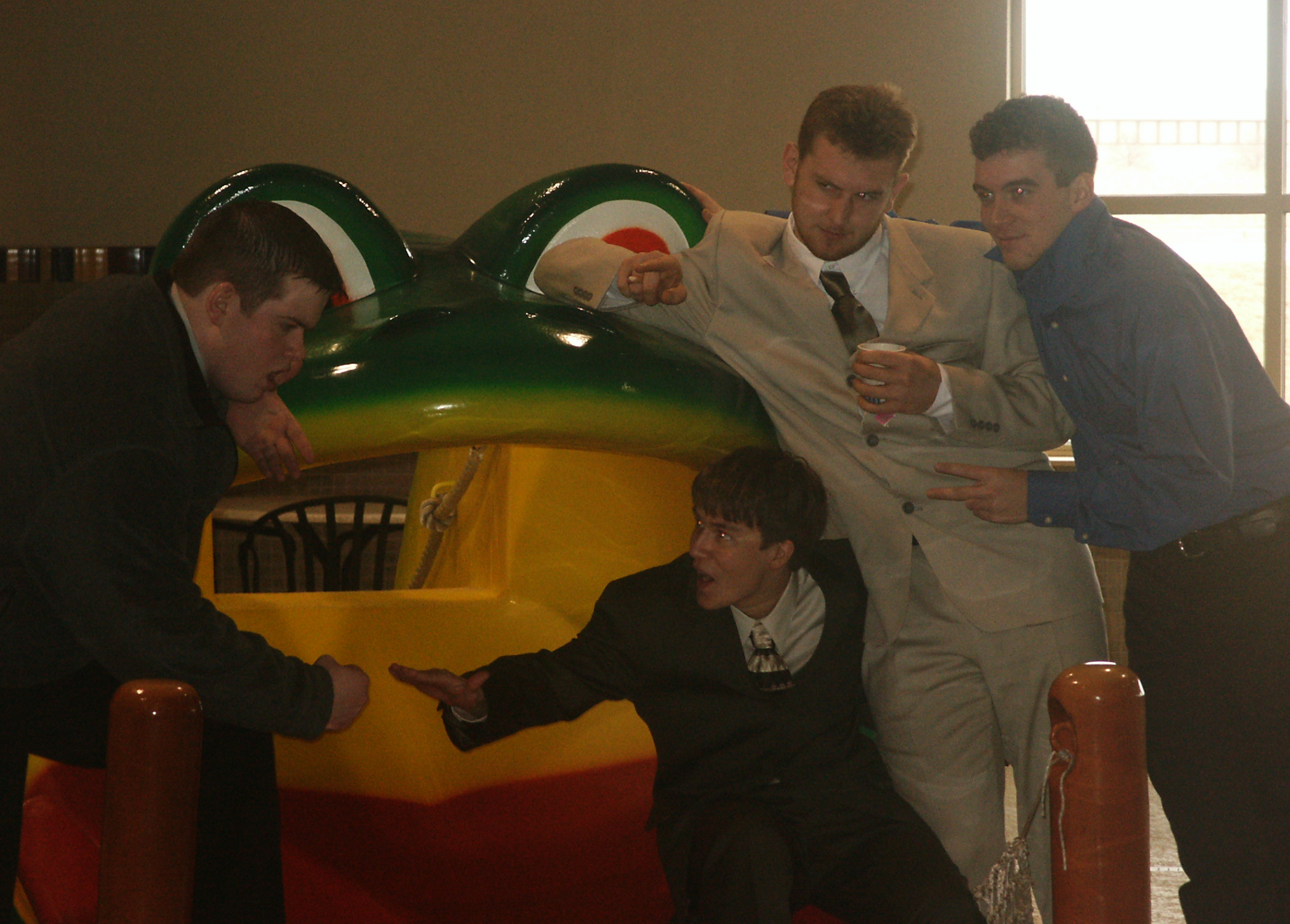
After a while I would identify other commonalities in music to attack: the proper way to play instruments, non-disgustingness of lyrics, types of juxtapositions of content and form, and standard components such as rhythm, melody, and tempos. We also explored all the satellite activities that constituted being in a band such as making music videos, producing records, battling other bands, creating the official soundtrack to major motion pictures, and even starring in our own documentary about the prices such an amazing band must pay for fame.

After exploring one factor thoroughly in experiments, such as the point of percussion in a song, I would relax the constraints on the banishment of this particular feature, and allow a song to have normalcy in this aspect while I experimented with some other part of music. Towards our later albums the contrarian-ness became more subtle and songs started to almost sound like real songs as I focused on attacking more and more specific parts of songs. For instance, the impetus behind the “Pee Pals” song was to see if I could make a simple song that people could dance to the beat whose content was also about something less appealing like peeing all over the dance floor. And this all started as an attack on the common reference in so many songs to the roof or ceiling as holding down the dancing. So in this song I tried to paint the picture of the roof holding in everyone as they literally drowned in their own piss as the dance room filled with party urine. Like all my songs, this exact sentiment may not have come across, but this manic process always did lead to something.

This still never directly answered questions for me about music as a whole, or even about this specific component (i.e. “oh, songs need percussion because of X”), but slowly I began to tacitly understand the impact of certain conventions. In fact, it was becoming clearer and clearer to me that music was a recursive set of conventions scaffolded deep in the trenches of history beyond memory.

Over the 15 years of this thought and analysis, I have currently arrived at two definitions that have been bouncing around in my brain.

Now prepare for conjecture…

Biopoesis

One of my earliest definitions for stating precisely what music is came to me at a Ladysmith Black Mambazo concert.

The group danced in front of the audience, and followed and played with the musical rule-sets. Musical algorithms developed amongst themselves and the unconscious genetic and cultural regulations governing our thoughts and bodies. As they twisted and undulated, and non-verbally encouraged the rest of the audience to clap along, I was struck with a vision of the creation of life. The arbitrary rule sets were no different than the arbitrary universal constants set forth to govern the universe at t=0; the entangled patterns that repeat themselves in these musical rule sets were no different than the forms, and behaviors that have distilled from the chaos according to the universal laws. Music was biopoesis. Music created the simplest version of “life;” a single note resonating against the void. The persistence of a pattern throughout space and time could serve as the simplest definition of a “living” entity for me, and music was the conjuring of these patterns. At a concert everyone participating is aiding in the birth, exploratory life, and eventual death of a living creature.


Ego Solvent

The other definition upon which I arrived for music was an oblique one. It defines music indirectly by describing the conditions for the experience of it.

My thought is this:

Music is what you receive when you are no longer an individual. Static and discord are only felt when a thing exists as an single organism. Musicality is what your bodily cells live in every moment of their lives until they die or turn cancerous (perhaps in cancer a different tune takes over, perhaps the biological equivalent of getting a terrible Coldplay song stuck in your head).

This definition had been with me for several years, but did not manifest itself as well into words until I made a concert video for peter and his friends in their band Ptarmigan. I had them perform an acoustic concert with Peter’s research animals, the Azteca ants living in Cecropia trees.

[Video of Ptarmigan’s performance in the jungle with their research creature/collaborators]

Watching them follow the secret patterns governing the actions between them (both the band and the ants), solidified for me that what we call music was the experience of living as a larger entity beyond our “individuality.” Also with things like Mirror-Neuron theory stating that our brains actually enact what we see others do, the idea that listening to music is cognitively similar to playing it removes a categorical distinction between musicians and audience. Thus living in music is the same as living in a superorganism. Living in static is living as a solitary singular creature.

To find the atomic organism at a given moment, we travel up levels of organization until the music experienced starts breaking down.

Music is the dissolution of identity. It is ego solvent.

It may be communication without meaning. A meaningless medium.

When social insects like honeybees slowly evolved an increasingly tight social co-dependence, the musicality of their everyday encounters would be increasing. Evolution is the ultimate composer, crafting species specific songs over millions of years. Individuals merge identities not through explicit goals, but through a developing drive towards a certain sought after harmony bred into their brains. The ant collects and returns food to the nest not because it has a stated intent of helping the group, and perhaps not even because she herself is hungry, but instead because she is caught in a musical rapture.

Brains are little more than multi-dimensional harmonic oscillators shaped by adaptation and genetics. They are software both learned and burned-in. These oscillators respond to our environment and actions, and when our behavior shapes the external world to vibrate our brains correctly we experience music.


Dissolution into the Conjured Being

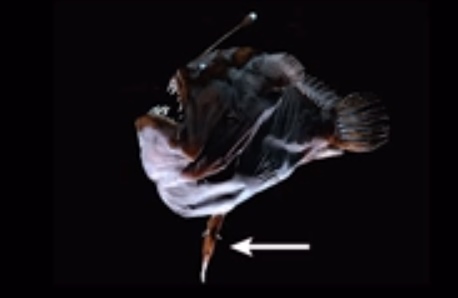
I think both theories are interesting to ponder, both music as the simplest living creature, and as superorganismal glue. They need not exclude each other also. Perhaps music is a creature to which we can become a part. Music can be the female anglerfish, and by following its siren spell, we the male anglerfish attach, dissolve and become just an additional appendage of this larger animal. The function of music as an art can be to let us create new forms of life, and leave ourselves to become part of this new creature, if only for a brief period.

The male anglerfish attaches to the female during mating and then dissolves its entire body leaving little more than an appendage of gonads for the female that produces sperm.(from letvc.com)