
In Panama with my jungle partner, Peter Marting, I created a short documentary about the strange, symbiotic relationship between Cecropia trees and Azteca ants.
Author Archives: digitalnaturalism_97q4dl
Bio-Inspired Design

In Fall 2012 I was able to join Georgia Tech’s Center for Biologically Inspired Design to participate in their interdisciplinary course. The experimental class brings together biologists, engineers and physical scientists who seek to facilitate research and education for innovative products and techniques based on biologically-inspired design solutions. The participants of CBID believe that science and technology are increasingly hitting the limits of approaches based on traditional disciplines, and Biology may serve as an untapped resource for design methodology, with concept-testing having occurred over millions of years of evolution.
Projects
- Pascobots – Desert Ant navigation and maple seed dispersion inspires a system design for rapid environmental surveying
- Fresh Kicks – Bio-Inspired design
- Several bio-provocative “found objects”
[rellink]
[/rellink]
LocalFlux Interview

Ants Secret Code – Reveal
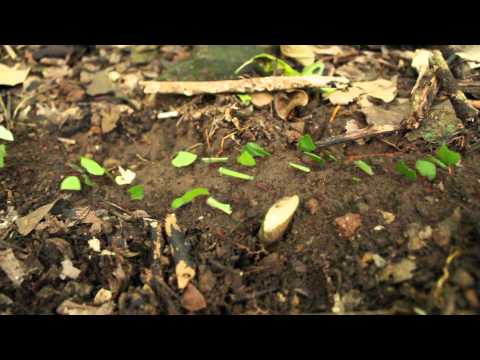
Earlier, I posted a video of leafcutter ants claiming that it contained a secret code. Well it’s true! Here’s how to crack the code, and how I encoded my messages in the first place.
Deciphering
The astute observer may take note that the ants carrying leaves only travel in one direction (towards the nest). In fact, this is the entire underpinning to the code. When I presented the puzzle to my lab, the response I got that was closest to correct was from Prof. Tucker Balch who stated that the first thing he would do is “chart the number of leaf carriers visible in each frame over time and look for patterns in that time series.” Good thinking Tucker!
The first step is to create a signal out of the leaf-carrying ants. To do this, one can simply take the green channel of the image and adjust a threshold until just the leaves are selected. To get more exacting data you could try to apply additional filters like blurs, dilations, etc on top of this thresholding. You can even use professional video compositing software like After Effects and “key-out” the green color. These additional improvements are not really necessary however, you can stay pretty crude.
Next, because there might be some extra foliage around the edges, you will want to crop to a region of interested just around the ants.

Example image targeting just the green leaves from the video.

The video should now be entirely white (255) in areas where the leaves are present, and entirely black everywhere else. I then made a simple script that tallies up all the white pixels (detections) present in every frame, and it saves all this data as a CSV. When I pop open this CSV file in an open-source equivalent to Microsoft Excel, and chart the results, I get something that looks like this:

Ahh, that looks like it might contain some sort of signal. Now’s the time for the cryptographic skills. Your first intuition should be that Andy isn’t that big on cryptography, and will probably just use the first temporal coding sequence that comes to his mind, Morse Code. If one takes the slightly wider pulses to be dashes and the slightly narrower ones to be dots, you can pull out this pattern:
— . – -.-. .–. .-..
Or translated from Morse->English: GT CPL
The Georgia Tech Computational Perception Laboratory (where I work).
Yay! I also have some additional videos where the ants say a couple other messages like “Digital Media” and, of course, “Hello World.” I even made a special message to the class of my cool Biology teacher sister. I will post them here when they are ready.
Both videos from this puzzle say exactly the same message, it is just that one, the first video, was recorded further down the stream which gave lossier data, so more human, visual intuition was required. The reason this data was lossier will be explained below. Additional props go to DM student Rebecca Rolfe who uncovered the unintentional Rebus of the video, “Soon there will be no leaves left” (Get it? Get it? Ants are carrying all the leaves to the right….)
Encoding
How did the ants know how to communicate this message? Well they probably didn’t.
Earlier in the summer, I wanted to test Leafcutter responses to temporary barriers. It turns out that if the barrier is only there for a short amount of time (<1 minute), the ants will just sort of pool-up behind it instead of walking around (note, this is not true of other ants, like Army Ants).
To get more precise results, I built a simple servo-device controlled by an arduino which was attached to a fluon coated plate. While I was cutting-off, and re-enabling the flow of ants, I realized I could also program this device to send ant-based messages in this fashion. Thus after lots of experimentation, and a long hot day sitting in the jungle with my ant tollbooth, I found a workable formula for sending dashes and dots, and made the servo go up-and-down correspondingly to whichever message I wanted to send.
Of course, I wasn’t 100% certain that it worked until I got back home and analyzed it myself!

Leafcutter Ants Secret Code
The video below contains a secret message:
I’ll reveal the secret and how to figure it out on Tuesday, so you’ll have all of Labor day weekend to ponder.
First one to email me with the correct answer gets a prize (don’t email the whole list- serve and ruin the fun!).
First one to email me with how to arrive at the correct answer gets mild applause 🙂
——————————-
Hint 1: To work with the video, it may be easier to download it all at once. Just pop the link into http://www.savevid.com/
Hint 2: (don’t use the hint unless you have to!): This video is slightly easier to decipher:
Magnetic Insect Testing
Not sure if people have been doing this for dozens of years in the insect world already (maybe this is common practice?), but I just ran some successful tests on an idea I had that I think could lead to some fun experiments.
I was reading the fantastic book, The Ants, and they were discussing how one of the interesting characteristics of working with superorganisms is that you can non-destructively turn them into mutants. Regular organisms tend to permanently change when you drastically alter them. You cannot do a quick test with an ape to see how it behaves differently if you remove its liver, or chop off its arm, and then return it to normal the next day. Regular organisms are quite fragile in this way.
As Holldobler and Wilson point out, though, Superorganisms are quite flexible. Interesting experiments can be done where various parts of the being are removed, like temporarily taking out all the ants in the soldier caste, and the hive can be returned to its original state at the end of the day.
I was trying to think of ways in which you could speed up this process and have a constantly, rapidly mutating colony. How might one be able to quickly remove a select target group of individuals from a nest (without sitting there hunting with tweezers).
Then I thought of magnets!
Magnetic paint already exists, but apparently only in aerosol or latex paint, not good insect friendly paint like enamel paint. So i tried out making my own. First I had some success with mixing iron filings with enamel paint.

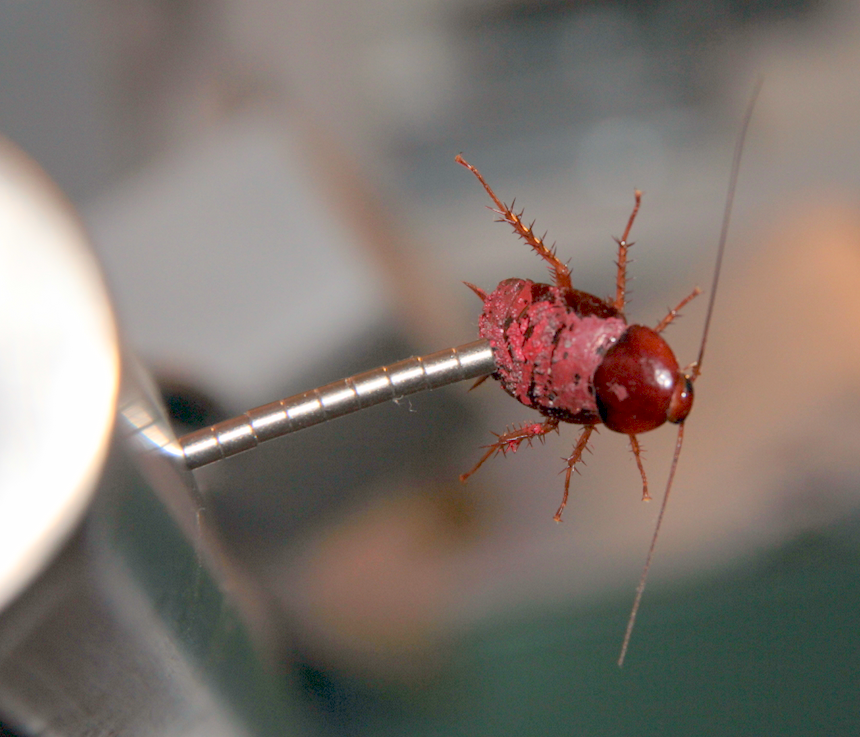
My first test subject, a palmetto bug, was sucessfully recaptured after her daring escape using her newfound magnetic properties.
But these filings were so large that they would rip through the paint and snap out over time. Then I found some (secretly) magnetic powder (that also has the benefit of being flourescent!), and I mixed it with the enamel. This gave me a nice smooth, very attractive paint which worked on large or very small surfaces!

Magnetic Powder Paint subject with many test-swatches.

The key ingredients, magnetic (fluorescent) fingerprinting powder, and enamel paint.
I was thinking you could make a certain target group magnetic, and use a switchable, on-off magnet to collect them and put them back in the nest. But then I was thinking of other fun things you could do with them!
For instance, if all your temnos were painted magnetic, you could use a tiny magnetic rod to more gingerly pick a single one out of a nest instead of worrying about hurting it with tweezers. Also we were thinking it might make them more capacitive, and their movements could be picked up by stuff like ipad multi-touch surfaces (not tested yet). Field scientists that need to recollect the same, marked bugs, can also use this to wave powerful magnets around in the bushes for recapture. The coolest idea, though is that you can somewhat manipulate their behaviors at will!

Determining if wet paint has become magnetic (pretty good, needs a bit more powder

Hand-painting small spot on live ant
Here’s a video I made doing a very informal test about how ants respond to a fellow who seems completely normal most of the time, but who sometimes starts flipping-out and sliding around crazy a la “The Exorcist.” The ants treat the magnetic ant completely normally until she freaks out, then they pounce and start biting her head. After the freak-out, they keep biting for a little bit, and then let go, and everything’s back to normal. On top of visuals I provide a andy’s-been-programming-too-long crazy narration of the events 🙂
My Tortoise Loves Me
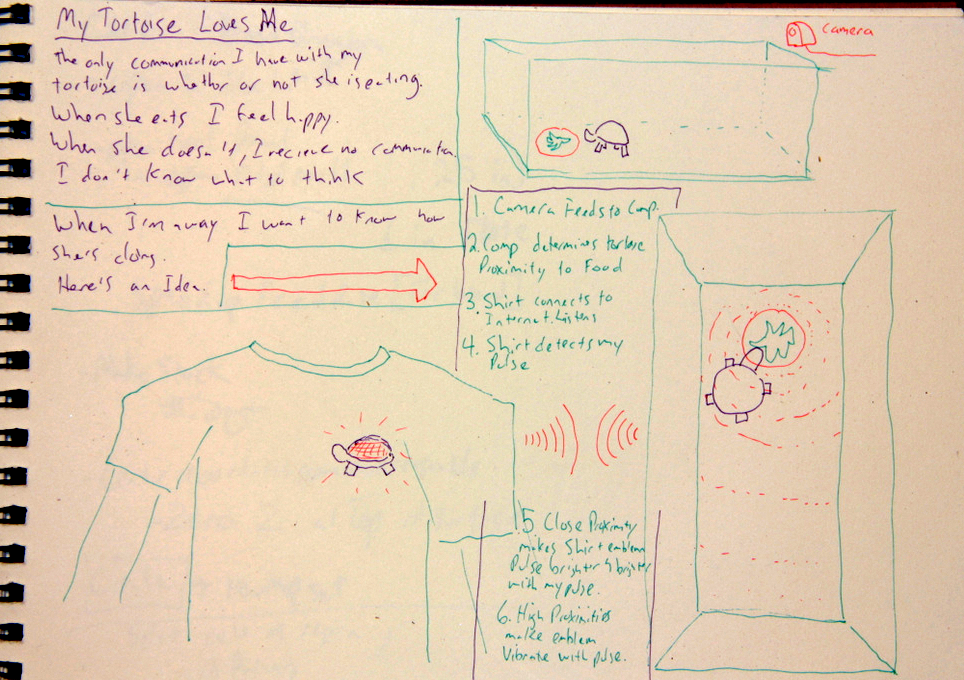
Idea for building relationship with my pet tortoise.

Bio-Tracking

I am the lead researcher on several scientific biotracking projects at Georgia Tech
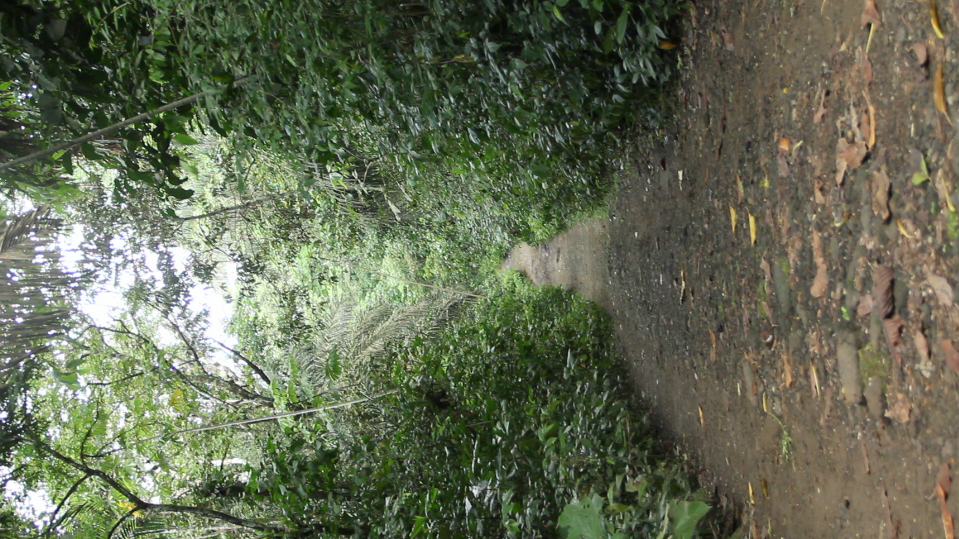
Final Pipeline | Soft Metrics
Last serious trip on Pipeline. What am I filming? The road. Camera pointed down the road. Regular and HDR video.

Could be used for detecting Blue Morphos, but also sitting with and observing this slice through the forrest.
First thought is just boring. Dead forrest with an occasional jungle truck or Blue Morpho. But there are some decent soft metrics one could probably pull from this. This constant, jungle monitoring camera. Daily weather patterns, wind, leaves falling, sounds, tree movement, general movement along transect, traffic patterns.
Chased butterflies. Figured out how to make Hamatam army-ants retreat.

It was a different day knowing that these probes and pokes would be my last.

Thinking about how tracking shots on a dolly look so beautiful because they are a rigid, grammatical way of representing 3D information. Each tracking shot is the temporal equivalent of a gorgeous data visualization.
Thought up a possible full title for my thesis-
Digital Naturalism: Cybiotic Media and Digital Biocraft for Exploration and Dissemination
Ants Love Human Blood | Termite Rebuilding
6/21/2012
Let’s hurry up and get some facts down. Quick for memory.
Early to bed. Up at 7:30 but not going till 9. K_____

Just went to cecropia lot for last bits of footage, sugar water testing and termite rebuildings.
Turns out they can rebuild one of these tunnels within an hour.
Long-ish lunch discussing experimental ideas for Peter with Stephen. Back to parking lot. Tested whether ants prefered the taste of human blood over sugar water. They really seemed to like the blood.
Met with Yann returning from San Blas.

———–
Wanted to go to Bambi talk. It’s impressive how organized biologist are in this STRI commune. (http://www.stri.si.edu/english/about_stri/seminars/index.php)
The talk was all booked however. Peter said his roomate wasn’t going, so I subbed for him. Turns out that guy wasn’t actually registered, but when I showed up to the guard guy, my real actual name was on the list. (Of course I didn’t notice that until after I told him I was Willie, got awkward when I told him my real name was andy)
Got a ride in the boat.

Saw Ummat’s talk. One of the best I’ve been to out here!

Came back to record Kenro’s interview, and attend Victoria’s going-away party.